Pruning Videos for Berries Bushes
Here are some videos on pruning berries going into spring. Enjoy!

Helping Tri-City Gardeners Grow Since 1940!
Job's Nursery LLC is a family owned nursery and tree farm that offers a wide selection of outdoor plants that are hardy for our area. We are located just north of Pasco on Columbia River Road. It's a short trip to a beautiful location to escape the hustle and bustle of your everyday life.
Here are some videos on pruning berries going into spring. Enjoy!

Our soils are alkaline (pH above 7) because of the areas low annual rainfall and the lack of organic matter. Alkaline soil can be problematic to some plants because if the soil pH is too high it makes it hard for some plants to take up vital nutrients. By selecting plants that enjoy these soil conditions it a lot less work to keep them happy. A good looking landscape with minimal effort, is much easier to maintain.
Below is a list of plant families that thrive in alkaline soil with little to no pH adjustments. From here you can find a variety that fits your yards needs and personal taste.
Ornamental Grasses
Maiden grasses
Switch grasses
Feather Reed grasses
Fescue Grasses
Fountain Grasses
Fountain Grasses
Shrubs
Sumacs
Junipers
Hydrangeas (though big leaf varieties are pink in alkaline soils)
Spirea
Barberry
Bluebeard
Forsythia
Lilacs
Butterfly Bush (sterile varieties)
Potentilla
Pines
Juniper
Spruces
Photinia
Ninebarks
Common Snowball Bush
Cistena Plum
Mockorange
Viburnums (Deciduous)
Smokebush
Cotoneaster
Perennials
Lavender
Daylily
Sedum
Candytuft
Daisy
Sages
Hosta
Astilbe
Helebores
Red Hot Poker
Catmint
Russian Sage
Black Eyed Susans
Blanket Flowers
Mums
Asters
Yucca
Yarrow
Trees
Bald Cypress
Serviceberry
Golden Rain Tree
Honeylocust
Pines
Bur Oak
Redpointe Maple
Hedge Maples
Persian Parrotia
Sycamore
Willows
Maackia
Green Ash (Urbanite is resistant to Ash Bore)
Catalpa

It’s so fuzzy! The Tiger Eyes Sumac is a yard friendly cutleaf sumac that looks like antlers in the winter; including having the velvet. It reaches 6 feet tall and wide. Tiger eyes leafs out in the spring with yellow to chartreuse green leaves. It's shape and texture resembles a Japanese Maples; but Tiger Eyes enjoys our hot summers. The only complaint that is tries to colonize but if you pull up the suckers keeps it in check. Enjoy the fall colors of oranges and red for a grand finale to the growing season.
Yellow Trumpet Vine is great for when you need yellow summer flowers that attract pollinators. The Trumpet Vine is aggressive so it does need to be kept in check with frequent trimming. Yet, if you need a narrow privacy screen this one works for it provides a thick foliage screen. It enjoys full sun and likes water. Don’t give it too much nitrogen to help keep it in check. Otherwise enjoy the flowers in the summer time.

The Green Spiral Fir is a small weeping tree, it provides a rich green color to the landscape with great texture. It gives the appearance that the needles spiral out of the trunk. It can handle full sun but needs to have consistently moist soil. Green Spiral reaches 25 feet tall and 15 feet wide with a mounding habit. Use this plant as a focal point and mix with dwarf Hydrangeas, daylilies or bee balm.
Hot and Cold Hot Poker is a hot and dry loving plant. It enjoys full sun and doesn’t mind being in hot gravel. The orange to cream torch flowers appear throughout the summer with deadheading. The flowers also attract pollinators really well. Hot and Cold reaches to 2 to 3 feet tall and wide with the torch flowers rising above grass like foliage. Red Hot Pokers play well with lavenders, yarrows, sumacs and junipers.

This week features plants that show well on cloudy winter days! We even took these photos on a cloudy day to show off their glow.
Goshiki False Holly is a medium shrub for afternoon shade spots. It grows 3 to 5 feet tall and wide. The leaves emerge pink, then tune green with splashes of yellow. Goshiki prefers well drained soils so it will go well with azaleas, rhododendrons and astilbes. It works great in small areas and can be trimmed easily to keep in check.
Chollipo Euonymus is a sun loving yellow variegated plant that grows to 12 feet tall and 6 feet wide. It can be used where you need a vertical height and for darker spaces. Chollipo can handle part shade to full sun spots. Like the Goshiki it prefers well drained soil, to be regularly watered and fertilized. Also trim to keep it in bounds if needed.

The Black Hills spruce is a smaller growing, tough spruce that doesn’t have as sharp of needles as the Colorado Spruce. It’s green color makes a nice specimen for Christmas lights. They grow to 35 to 40 feet tall and 15 to 20 feet wide. It handles all of our area’s landscaping quirk of sun, heat, cold and soil pH.
The Midnight Rose Coral Bells is a dark purple variety with flecks of hot pink that stand out in shade gardens. Coral bells prefer afternoon shade in our area (noon to 5) and would prefer to have well drained soil. In spring it flowers white. Midnight Rose Coral Bells with their dark foliage contrasts well against bright green foliage to yellow foliage plants like hostas, hydrangeas, or astilbes.
Here are 5 newer shrubs that have been introduced in the last couple of years that I have found to be: exciting, easy to care for, perform well in our area and will be in inventory this spring.
Purple Pillar Rose of Sharon-Purple Pillar is a columnar Rose of Sharon that only gets to 2 to 3 feet wide. Blooms purple with red centers from July to September. It enjoys full sun and heat for best bloom performance. Purple Pillar works well on corner of houses, narrow beds that need height between windows, or for hedge plant to add color to an evergreen hedge.
Diamond Rouge Hydrangea-Diamond Rouge is a sun loving Hydrangea that blooms white and turns to raspberry pink earlier and doesn’t depend on temp to trigger the color change. It also has a nice upright habit and is less prone to flopping over while in bloom like previous varieties which means less pruning needed. They grow to about 4 to 5 feet tall and 3 to 4 feet wide. Another bonus is the red fall color it turns in October.
Fireside Ninebark-Fireside Ninebark is a dwarf ninebark that features the rich red purple foliage but keeps a more compact form of 5 to 7’ tall and wide. The foliage has the appealing larger leaf of Diabolo that grows to twice the size of Fireside. It enjoys part sun to full sun spots, and doesn’t mind our winds. Works well as a hedge for privacy or where you need a color contrast against a fence or flower bed. Ninebarks are also thorn-less.
Fire Island Hydrangea- Fire Island Hydrangea is great for afternoon shade areas of the yard. It is a dwarf Hydrangea that only grows to about 3.5 feet tall and wide. It starts blooming in early summer and goes into fall for it blooms on both new and old wood. So you get blooms no matter how hard a winter is on the plant. The pink/white colors of the bloom shows nicely in shade.
Lil’ Flirt Spirea -Lil’ Flirt Spirea is a tiny Spirea that is just as durable as it’s bigger cousins. It grows in pretty much any soil condition to 2 1/2 feet tall and wide. It enjoys partial to all sun as well. Lil’ Flirt stays compact and starts blooming in May with repeat blooms throughout the summer. More so if you shear off the old blooms periodically. The compact habit lends this Spirea to work well in perennial beds or as a border plant.

The Weeping Norway Spruce is a classic, durable weeping evergreen for the Tri-Cities. It handles full sun to part shade, our range of temps from summer to winter and our soils with ease. The Weeping Norway Spruce is also flexible to how you train it. You can twist it, train it upward, or let it creep along the ground. The versatility is endless. It’s mature spread is 6 to 10 feet.
The Fiji Rose of Sharon is for full sun spots and has a long bloom season. The pink/white blend stands out well whether it’s a sunny day or in moonlight. This plant is available as a shrub for privacy or accent as well as a small “tree” for focal points. It grows to about 10 to 12 feet tall and six feet wide. The more sun it gets the better for it needs heat to bloom like it’s cousin the dinner plate Hibiscus. Keep it well fed and hydrated so Fiji won’t disappoint.

Angel Falls White Pine is a weeping pine with blue green foliage. It’s needles are soft to the touch versus the spiny feel of the Austrian Pines. The blue green foliage lends itself to contrasting red, dark green, or yellow leafed plants. The Angel Falls mature size depends on how tall you train it. 12 to 15 feet would be the tallest it grows upward if trained. Training Angel Falls upright is simple, you tie it to a bamboo stake, move the stake upward and retie as needed. The flexibility of training the plant lends itself well to focal points near the corner of the house, blank walls or corner where something tall is needed. Angel Falls prefers at least 6 hours of sunlight.
Whipcord Western Red Cedar is a dark green mop-head evergreen. This one is just cool when put in the yard. It breaks away from the standard upright globe shaped plants. The dark green plays well with different shrubs and perennials. It also enjoys full sun (at least six hours) and moist but well drained soils. Whipcord grows to about 4 to 5 feet tall and wide.

The Baby Blue Eyes Spruce is a dwarf Colorado Blue Spruce that reaches 20 to 30 feet tall and 10 to 15 feet wide. It’s slow growing, so it takes awhile to that large. It enjoy a wide range of soil conditions and like the rest of the Colorado Spruce family they do very well here. Our sunny weather actually bring out the blue color! It’s great to use for bird cover, Christmas lights and focal points.
Sheila’s Perfume rose is a delightful Floribunda Rose (flowers in clusters). It grows to about 4 feet tall and wide. It’s blooms resemble a Hybrid Tea in form and size. Sheila also isn’t prone to powdery mildew but it’s still best to not water her going into the night and making sure she has at least 6 hours of sunlight a day. Sheila has a strong fragrance which is nice to enjoy in the garden or in a bouquet.
A common question we get is when to prune your grasses for winter. In reality it can be as soon as that plant dies back to the ground. I personally use the grass’ foliage as a winter interest, so I will wait until the winter winds beat then up into a mess. Then I tie a string around the top and cut back to within an inch or two of the ground. For evergreen grasses, I just clean out the dead foliage. With Pampass grass, I wait until spring, using it’s foliage as a mulch to help it survive winter since it’s more tender than other grasses like Switch grass, Japanese Silver grass or Fountain grasses in our area. Below is a video I did to demonstrate how to cut back the different types of grasses.
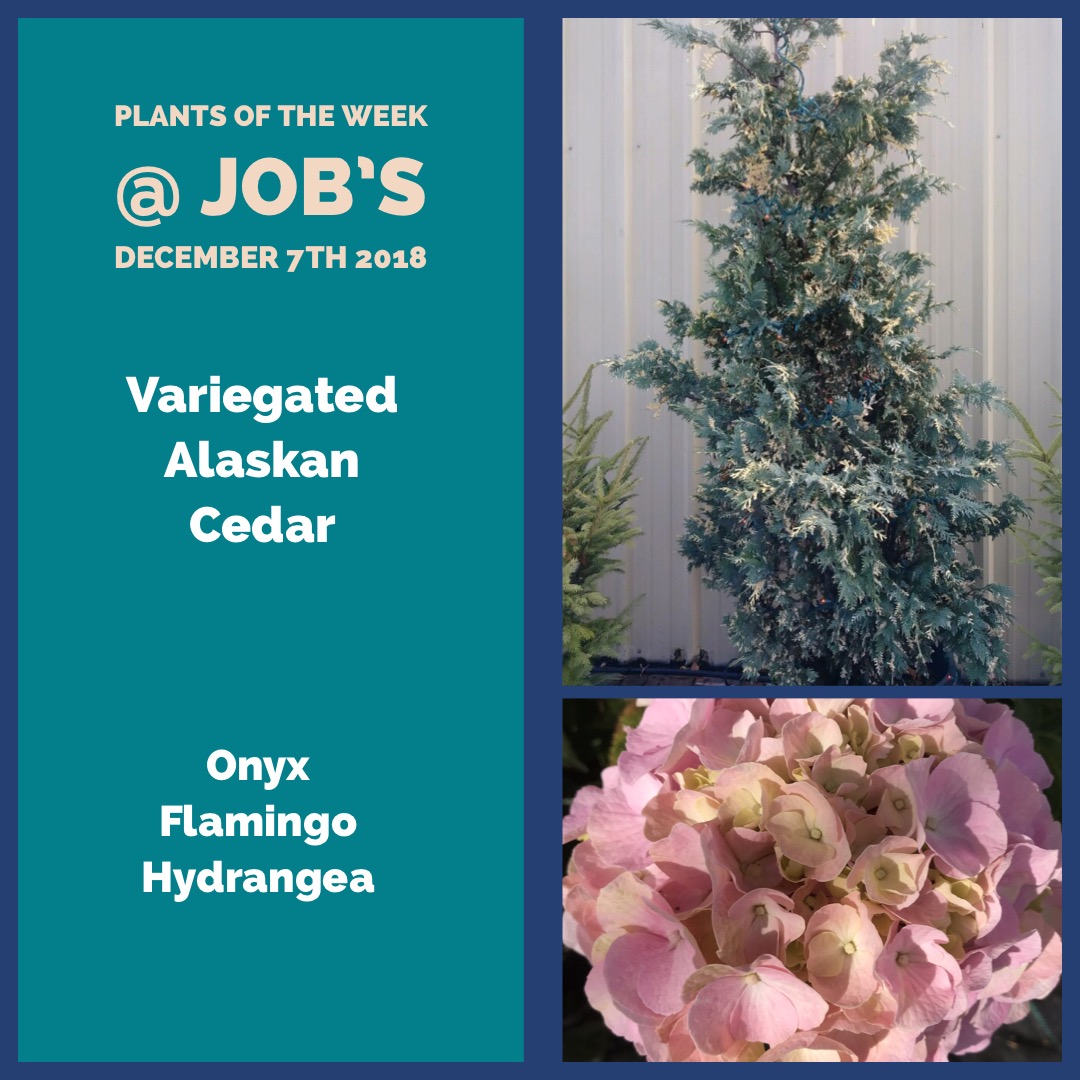
The Variegated Alaskan Cedar is an evergreen tree that gives a yard texture, height accents, or just a good block. The foliage is dark green with a smattering of yellow needles. This tree grows to about 20 to 30 feet tall and 12 to 15 feet wide, making it a small tree. They can handle fun sun, though strong winds when it’s over 90 can lightly burn the yellow.
Onyx Flamingo Hydrangea is a type of big leaf hydrangea that loves afternoon shade in our hot summers. The pale pink bloom clusters is striking when compared to both the black stems and the dark green foliage. It grows to 3 to 4 feet tall and wide. It also blooms on new and old wood, so now matter how bad winter is, you will still have blooms. If you would like a pale blue version of this, just treat the soil with sulfur, G&B Acid Planting Mix or Aluminum Sulfate to acidify the soil.

Both of these two perennials featured this week are for afternoon shade to total shade spots of the yard. They both enjoy moist soils and have great foliage texture to provide the entire growing season with color.
Firework Rodersia reminds me of something you would see out of Jurassic Park. The large leaf and deep texture would be ideal for craft projects. It grows to about 3 feet tall and 3 to 5 feet wide. In late spring early summer it flower fine pink clusters. The real reason to plant this is the green with bronze edged foliage that contrasts hydrangeas, hinoki cypress or japanese maples.
Praying Hands Hosta is a dwarf hosta that has twisted green foliage. It has this gorgeous golden yellow fall color seen above. It grows to about 14 inches tall and about 2 feet wide. It can be a border plant to a shade garden or a stand alone feature in a bed that is small in stature. Praying Hands is also resistant to slugs!
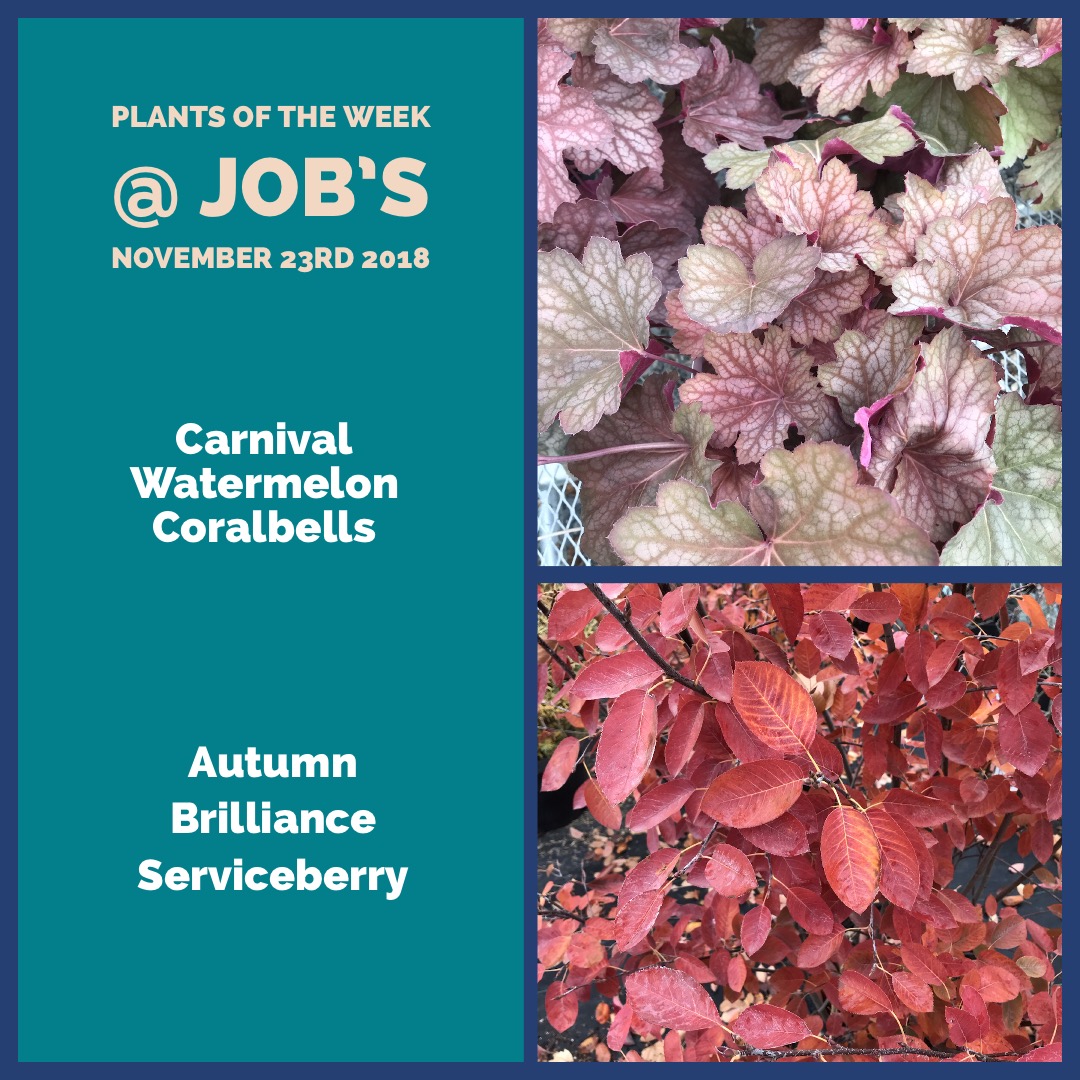
The Carnival Watermelon Coralbells are great border plants for Tri-City shade gardens. They can play well with Hostas and contrast well with Hydrangeas. Carnival Watermelon reaches 12 inches tall and 2 feet wide. The foliage ranges from a frosted peach to a copper purple. It’s does best with afternoon shade in the Mid Columbia because they don’t enjoy getting dry. In mild winters it is an evergreen as well.
The Autumn Brilliance Serviceberry is a large growing shrub or small tree. It has with spectacular fall color with reds and oranges. They grow to about 20 to 25 feet tall and wide. In the spring they flower white. In summer develop purple black berries that are great for bird habitat. You can also make jams and jellies with them. Autumn Brilliance works great to provide a screen when in shrub form. Or as a small shaped tree with irregular branching. Handles full sun to part shade conditions.

The Blue Muffin Viburnum is a tall shrub (5 to 7 feet tall and wide) for partial shade to full sun. It has white flowers in the spring and blue berries that appear in summer to feed birds. The most striking surprise this shrub has is it's fall color. The fall colors range from fire engine red to burgundy. It is also deer resistant and very cold hardy (USDA zone 3).
October Daphne Sedum is a hardy succulent that enjoys sunny hot spots in the yard. It can also enjoy drier spots too. The blue gray foliage reaches about 6 to 12 inches tall and spreads to 24 inches wide. In late summer it flowers the pink flower pictured above that attract butterflies.

The Dwarf Fothergilla is a small sized shrub that has exquisite fall color! It is a slow growing plant that reaches 2 to 3 feet tall and 3 to 4 feet wide. Green in the summer time and in spring it has fragrant white flowers that remind me of a bottle brush. Forthergilla grows well in full sun to partial shade (4 or more hours a day).
The Kwanzan Cherry is a flowering cherry tree that grows to 30 feet tall and 20 feet wide. Most known for it’s double pink blooms in the spring, it has a surprising nice fall color. The yellow and oranges contrast with red fall color like maples, burning bushes or fothergilla really well. Prefers full sun but does best not being next to sidewalks and streets for they don’t like the reflected heat on their trunks.

The Gold Flame Spiraea is stunning in the fall with a nice bright red fall color. It grows to about 3 to 4 feet tall and wide. Gold Flame handles full sun to part shade as well as being versatile in many landscape areas. In the summer it has a gold/green and has pink flowers in the late spring and summer.
Golden Colonnade Ginkgo is a ginkgo with a strong central leader. Unlike other ginkgos that enjoy being naturally free form. It matures to 45 feet tall and 25 feet wide. Ginkgos do well in the Tri-Cities and are very durable. The fall color is a brilliant golden yellow like the ginkgos on Haines St in Richland. Except Golden Colonnade are male, so no stinky fruit!

The Burkwood Viburnum is stunning this time of year with it’s yellow and reds. It colors a little later than the burning bush. Burkwood Viburnum is a large growing shrub fo 6 to 10 feet tall and 5 to 6 wide. It can live full sun to partial shade and is not too picky when it comes to soil type. In early spring it has fragrant white snowball like blooms.
The Amethyst Oakleaf Hydrangea is a hydrangea that lives in full sun to part shade. It has gorgeous maroon red fall leaves that are shaped like oak leaves. In the growing season the leaves are green and in July, it flowers cone shaped white blooms that turn quickly to wine red. It grows to 5 to 6 feet tall and wide.

Berry White Hydrangea is a sun loving Hydrangea with red fall color! It reaches 6 to 7 feet tall and 4 to 5 feet wide. In July it flowers white and ages to pink. Berry White also stays upright more so than Vanilla Strawberry. Like other paniculata Hydrangeas it enjoys full to partial sun (4 or more hours of sun).
Fireside Ninebark is a new dark leafed ninebark that has bigger leaves compared to other dwarf ninebark. It grows to about 5 to 7 feet all and 4 to 6 feet wide. A great option for where you need a dark foliage color without the thorns of barberry. In the May it flowers pink/white flower clusters. Can be used as a hedge or as a focal point. Best to be planted in full sun (at least six hours).

The Mini Twists Pine is dwarf eastern white pine with twisted needles for a cool effect year round. It reaches 6 ft x 4 ft wide. Like full sun to partial shade conditions. It is great for a garden that needs a durable year round effect without the size of other pines.
Redpointe Maple is a newer red maple that is yard friendly reaching 45 feet tall and 30 feet wide. It has a great red fall color. Redpointe is not fussy when it comes to soil pH like Brandywine or October Glory can be in sandy soils. Redpointe continues to retain a nice green summer color and fall color performance. It still needs to be fed regularly for optimal growth performance. It’s a quick grower and has some small helicopters. A very clean tree when it comes to maples.


