Organic Seed Potatoes are here at Job’s Nursery, Spring 2026
Seed Potatoes have arrived and Job’s has a fun selection of varieties to play with in your potato growing endeavors.
Read More
Helping Tri-City Gardeners Grow Since 1940!
Job's Nursery LLC is a family owned nursery and tree farm that offers a wide selection of outdoor plants that are hardy for our area. We are located just north of Pasco on Columbia River Road. It's a short trip to a beautiful location to escape the hustle and bustle of your everyday life.
Seed Potatoes have arrived and Job’s has a fun selection of varieties to play with in your potato growing endeavors.
Read More
The Rapitest Digital Soil Thermometer is this week's feature because it easily tells you what the soil temp is. Why is this important? Because it helps guide you on when it is time to plant or transplant your veggies plants. Most seeds germinate best when the soil is at optimum temps. Transplants take off faster when they have their feet at the right temp. Most seed packets will have the soil temps needed for a specific variety on them. If not, a quick google search of what you are planting and the soil temp will bring up that pertinent info. Help eliminate the guessing game of knowing when is it the right to plant with a digital soil thermometer!

With the snow soon to begin melting with warmer temps, fortunately you haven’t missed out on too many garden activities, you just going to have to be ready to do some of the chores in a quick fashion because it’s going to change quickly when it does.
Prevention Spraying with Dormant Oil and Copper Fungicide as long as the buds are hard and it’s a day above 40 you can still spray with the dormant rates on the label. If you miss it follow labels instructions on what to do for the different stages of growth for the plants you are spraying for.
Applying Crabgrass Control. You actually have a lot of time for this as in before May. In fact it would be easier to apply and activate when the irrigation water comes on in April vs applying it when the Forsythia bloom and timing it with rain to activate it.
Dormant Pruning for Roses
This can be done as long as the leaf buds have not begun to pop. The basics for pruning roses are to cut them back to 2 feet then remove diseased, damaged, dead and crossing canes. For climbing roses, go ahead and leave tall just remove the diseased, damaged, dead and crossing canes.
Dormant Pruning Fruit and Berries
This can also be done while the buds are hard. To check this you want to feel the bud with your finger. If it’s hard and doesn’t give or squish under light pressure you are good.
Fertilizing your lawn, trees, shrubs and perennials.
Feeding your plants is a good thing but wait until April like normal because the plant will be awake enough to feed upon the fertilizer as well it is easier to water in with your watering systems.
Cutting back ornamental grasses
Cut them down as soon as the snow melts because once it warms up enough they will begin to grow again for the season and you will only be able to cut them back to as far as they have emerged to.
Cutting back perennials
Either pull off the dead material with your hand or cut it down. Unlike grasses it easier to see the new foliage emerge that you work around it and completely remove all the dead stuff.
Spraying weeds
Round up, Burn Out and other similar herbicides actually work best when temps are in the sixties, so there is plenty of time for this. No need to jump the gun. If the winter weeds are bothering you too much, you can always pull or hoe them out after the snow has cleared.
Applying Pre-emergents
This can be down actually any time of year but it is easier to do when the water is on to water the product in. Just remember to weed or spray the area really good beforehand.
Planting trees, berries and fruit trees
Your time will be short for bare root stuff but potted and B&B trees you have plenty of time.
Planting shrubs and perennials
Most of these plants are potted and can be planted year round. So once the ground is workable again until it’s over 90 you can plant these.
Planting annuals
Annual flowers like petunias and marigolds its best to plant those more toward May when the ground warms up. Primroses and pansies would be good to plant when the snow clears.
Here are some videos on pruning berries going into spring. Enjoy!

Fall is upon us and it’s time for planting. Here is what you can plant now and into winter as well as a few tips to make sure things go well.
You can plant plants rated zone 6 or lower for they can withstand our winters. You can plant trees, shrubs, perennials, roses and evergreens.
Even though the irrigation systems are going offline. Plants aren’t using much water. Until deciduous plants drop their foliage check on them for moisture weekly. After they drop their foliage check monthly to see if they need a drink. Evergreens need water on a monthly basis. Water on days where the highs are above 35 degrees.
For roses you want to mulch their crowns as a precaution against sudden cold snaps.
You can plant in fall and into winter you want to avoid cold snaps where on daytime temps don’t rise above freezing. It’s hard on you and the plants when the ground is frozen.
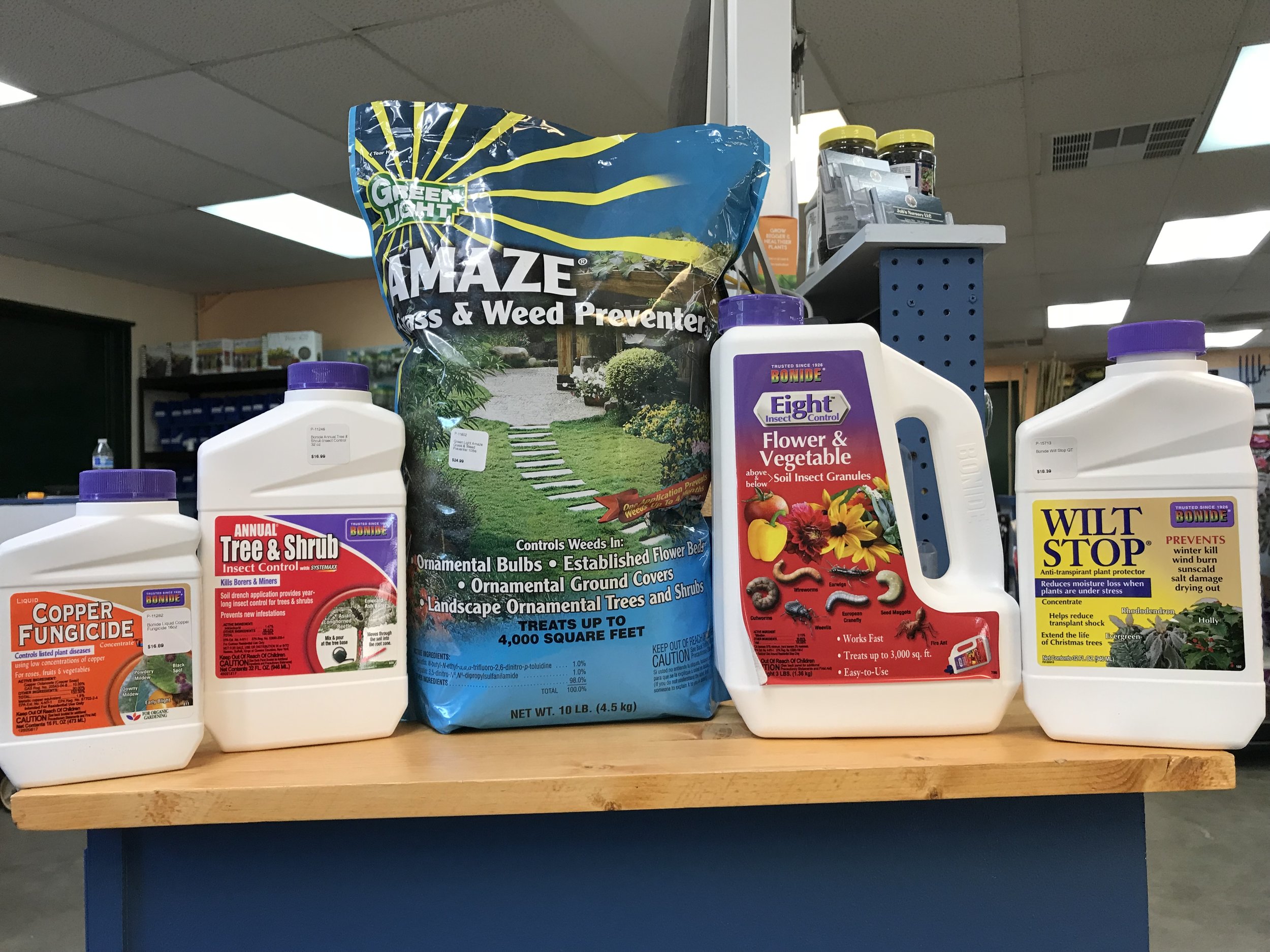
Fall is a great time to start spring off right, be doing a few preventatives.
1. Prevent aphid problems with the Bonide Annual Tree and Shrub Insect Control. By applying in August/September this gives the insecticide time to move up the tree and prevent attacks in Spring.
2. Prevent weeds in from growing in winter and early spring by applying a pre-emergent herbicides. Pre-emergent herbicides prevent weed seeds from germinating. Applying now, after clean weeding a flower bed will help prevent winter weeds from germinating and popping up in early spring. Products to look into are Greenlight Amaze, Preen, Round Up Extended Control. Make sure to follow their watering instructions on these product's labels for best results.
3. Prevent drought stress by applying Bonide Wilt Stop to your soft needle and broad leaf evergreens. It works like like lip balm for our lips to keep their leaves from drying out. Also mark when to water your evergreens in your calendar, it would be best to set it to once a month November through March. Use a sprinkler on a hose to water since the irrigation is turned off at that time of year. Yews, photinia, boxwoods, arborvitae, rhodies and others benefit from a monthly drink.
4. Help gain an upper hand with root weevil, by applying Bonide Eight Granules to kill the overwintering larva in the soil, thus reducing their population to help to keep them in check next year.
5. Green up your yellow trees and shrubs that normally should be green by applying the G&B Acid Planting Mix and G&B Harvest Supreme as a mulch or top dressing. By putting about 2 inches thick to slowly leach nutrients into the soil over winter and spring to catch these plants up on nutrients.
6. Clean up disease issues by spraying areas of the yard that had disease issues like rust, powdery mildew, leaf spot, peach leaf curl in November or February with a dormant application of Bonide Liquid Copper Fungicide. This sanitizes the plants to give a fresh start next spring. For best results make sure to clean up the diseased leaves as well as when you spray, spray the entire plant including the trunk.
7. Get your lawn off to a great start in spring by applying a fall feeding of a Fertilome Winterizer or Fertilome Greenmaker in September/October. These fertilizers will slowly feed throughout winter to build up the lawns nutrient reserves for a lush push of green growth in spring.
Watering for the First Year
In the first growing season, all new plants (including drought resistant ones) need extra water to allow them root into the surrounding soil. Make sure to deep soak the plants enough with a sprinkler on a hose; so that your soil is moist to 12 inches below the surface of the dirt a day after you have watered. You want your moisture to soak in this deep so that your plant’s roots develop deep and can handle not being watered for a few days in case there are problems with your irrigation system. If in doubt, you need to dig down 12 inches with a shovel, trowel or use a soil probe to make sure you are soaking in deep enough.
A general deep soaking schedule for sand loam soil (the main soil texture for Tri-Cities) it is listed by day time high temperatures
50 ̊F or less once a month for evergreens, check every two months for deciduous plants 50 to 70 ̊F deep soak once every two weeks after foliage emerges or drops on deciduous
70 to 85 ̊F deep soak once a week for one hour
85 to 95 ̊F deep soak twice a week for two hours
Above 95 ̊F soak three times a week for two hours
After all wind storms when temperature highs are above 85 ̊F go check the soil moisture.
**For Clay or compacted soil you will need to shorten you water run time and increase the amount of time your water to get the same effect**

Here are the signs of under watering your plants.
Read More
An example of inward growing branches

Here is a tree top that was broken during shipping along an old injury
Some of our trees come in as potted liners, they are allowed to grow and are blank slates for nurseries like Job's to grow them on from there. First we start by fixing the top by removing all inward growing branches, double leaders, damaged branches or tops and dead branches. Then we tip back side branches about 6 inches to an outward facing bud to encourage the trees to fill out without being bushy.
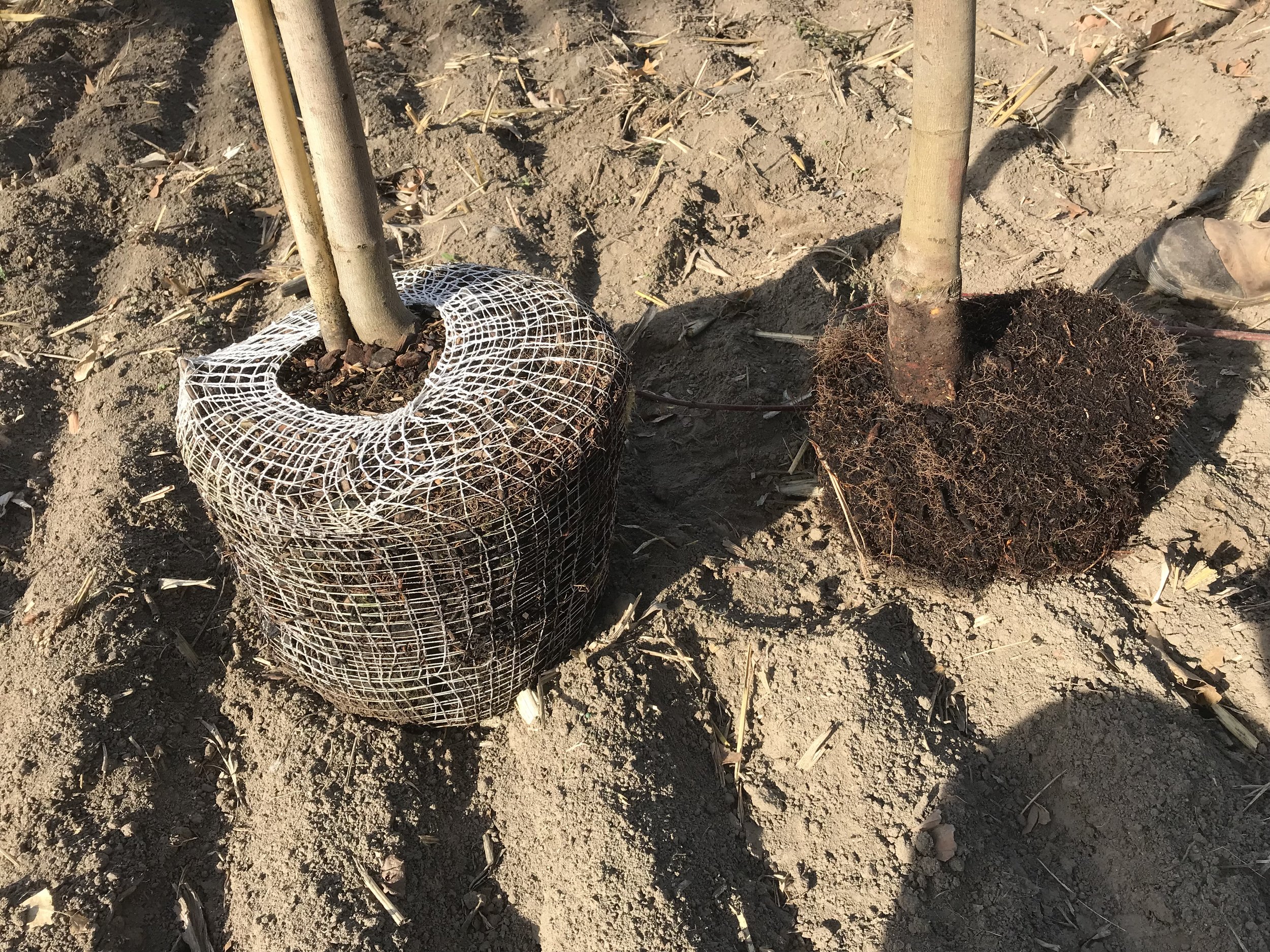
Before and after photos of root corrections
The next step is to fix any root problems. We verify that the root flare is an inch away from grade. If it is not, we remove the surface dirt until it is so. For potted liners as seen in these photos we also cut or score the roots to ensure the roots continue to go outward into their new soil. It's the same as when you plant trees. Sometimes it's amazing how deep a tree has been potted. The photo below shows some of the more drastic corrections we do.

Arthur hold a tree before he has gone through it and a tree that he has finished.
Once the tree has had both its roots and top gone over, we pot them and allow them to finish out. This generally will take a couple of growing seasons before we allow the tree to join the inventory at the store. It must be solid in it's pot and root just reaching the edge of the pot. This helps minimize transplant shock when planted in your yard.

Early April is when the irrigation water come back online is a great time to feed you trees, shrubs, and perennials.
For your plants you can use granulated fertilizers or fertilizer spikes. Which ever is easiest for you to apply. I find it faster and easier to use granulated; this is mainly because I have a lot of shrubs and my soil is very rocky. I just measure the size of plant and give it the appropriate amount listed on the label and then onto the next plant. Once I am done fertilizing I run my irrigation system to activate the fertilizer.
Three of my favorite plant foods for trees, shrubs and perennials are the Fertilome Azalea, Camelia and Rhododendron Food, the Fertilome Start n Grow and the G&B Paradise (organic). The Fertilome Azalea, Camelia and Rhododendron Food is great for plants that like acidic conditions like Rhodies, Dogwoods and Maples; you apply this one three times a year April, Memorial Day and Mid August. The Start-N-Grow is a good universal plant food full of trace elements that you only have to apply twice a year April and July. Paradise is a granulated organic fertilizer that is full of enzymes and trace elements to feed plants, apply in April, June and August. Any of them will yeild happy well fed plants!


Bermudagrass is problem for a lot of Tri-City lawns. It is the grass with deep roots and runs it's tendrils throughout the yard spreading where ever it feels like it. Bayer has come out with Bermudagrass Control for lawns, it is a growth regulator that supresses the growth of the Bermudagrass and lets your preferred lawn to choke it out. Timing is critical on applying it, you want to hit the Bermudagrass when it begins to emerge in early April, then repeat applications on a monthly basis until it is no longer trying to grow. Easy to apply with the Read to Spray Bottle (RTS), just hook to a hose and begin spraying only the affected areas of the lawn. Be sure to let the product dry completely after application, before letting kids or pets back on the lawn. We stock it regularly here at Job's.

This is my thought process on when to yank a rose bush if it has bolted.
Read MoreTuning your irrigation system allows for a more efficient use of water and it's easy. It also helps prepare your plants for different weather shifts and you apply water based on that irrigation zones conditions. Both Hunter and Rainbird have free apps to set your run times more appropriately for established yards. Also we have set up links to help determine your yards conditions. Remember that new plantings their first year will need to be babied a bit more but they don't need daily water.
A link to Hunter's App
A link to Rainbird's App
Things to know as you tune your irrigation timer
-The soil type of your yard: Sand, clay, silt or a mix of the three (loam). This will help identify how your yard behaves in drainage and moisture retnetion. Sand has very good drainage and can handle longer run times of sprinklers but needs more frequent runs. Clay soils hold moisture very well however it does not take to long run times well, short bursts work best to prevent run off and water waste. How to tell soil texture by feel.
-The exposure of that sprinkler zone. Full sun, afternoon sun or wind exposed sprinkler zones dry out faster through evaporation than afternoon shade, mostly shade and wind protected zones. Thus as you adjust your sprinkler zone times based on their separate exposures. This can be determined by taking time to walk around the house a couple of times of day and observe what area is sunny and what area is in shade at what time of day and for how long. Do this on a lazy day off.
-Your type of sprinklers. Different sprinkles types throw out water at different rates. Common sprinkler types are rotors, impacts, sprays, bubblers and multi-streamrotors. Also if you have drip, what size of emitters are your using. Irrigation System Component Video can help you identify what type of sprinklers you have.
-The grade of the yard. Is it flat or does it slope up or down? The slope of your yard also affect how sprinklers work as well as how water will travel in the yard. Here is a video to determine slope.
by Alex Job
Starting the garden or refreshing the garden starts before you buy a seed or transplant.
Place the garden in a space that is in a sunny spot, afternoon sun is best.
Written by Alex Job
Vegetable gardens can be started by seeds or transplants. A lot of vegetables are available both ways, sometimes its advantageous to go one way or the other.
Seeds- Are inexpensive, however if you planning on starting the seeds indoors you are going to need pots, potting soil, fertilizers, space and the time to care for them. Some vegetables are easy to plant in the ground when the time is right, these include lettuce, radishes, carrots, spinach, mustard, melons, beans, peas, corn, cucumber, squash, and pumpkin. While tomato, eggplant, celery, peppers, broccoli, and cauliflower require indoor starting to get them to produce on time, this can be 3 to 5 weeks before planting time. Also how much do want of each crop, if your just feeding the household you may want to limit your number of starts, so your not overwhelmed with one crop or another.
Transplants- These are plants that have already been started and ready to plant when the time is right (weather and ground conditions). Instead of buying seed packs of every variety you want to grow or try, you can buy only what your garden has room for or what you want to contend with. This allows you to have several varieties of a crop to mix it up a little or experiment with new varieties, while still having some old favorites.
Here is a list of Plants and which way is best, easier or convenient to have from seeds (S) or transplants (T). It really all based on how much work you want to do.
Beans (S or T)
Beets (S)
Broccoli (T)
Cabbage (S or T)
Carrots (S)
Cauliflower (T)
Celery (T)
Corn (S or T)
Cucumber (S or T)
Eggplant (T)
Lettuce (S or T)
Melons (S or T)
Onions (S or T)
Peas (S)
Peppers (T)
Pumpkins (S or T)
Radishes (S)
Spinach (S or T)
Squash (S or T)
Tomato (T)
By Alex Job